
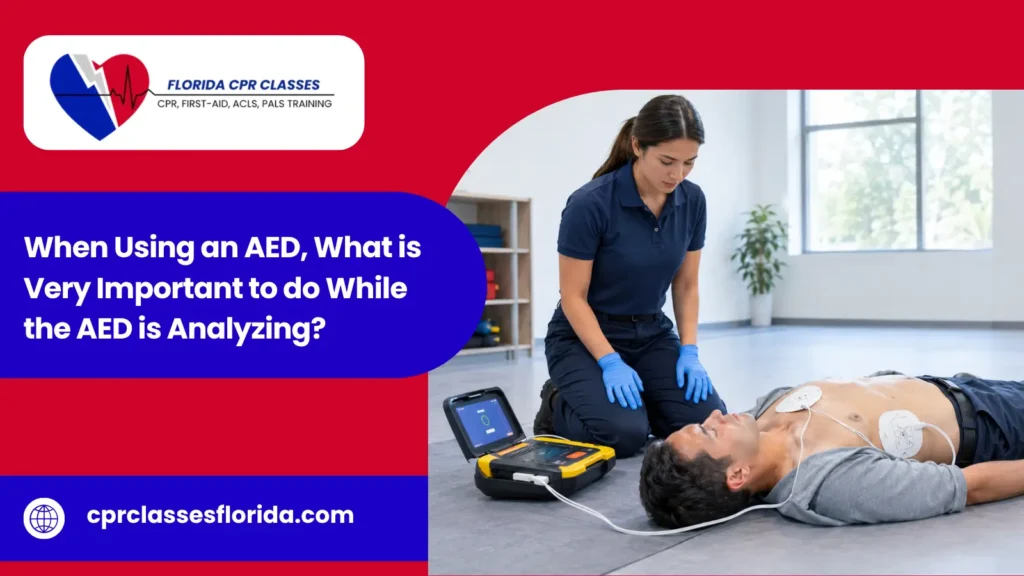
An Automated External Defibrillator (AED) checks a person’s heart rhythm during cardiac arrest to determine whether a shock is needed. While the AED is analyzing the heart rhythm, rescuers must follow the device’s instructions and make sure no one touches the person. Any movement or contact during this process can interfere with the AED’s analysis.
This guide explains what rescuers should do while an AED analyzes a person’s heart rhythm, why no one should touch the person during this process, and what mistakes to avoid.
What Happens During AED Heart Rhythm Analysis?
Once the AED is turned on and its electrode pads are placed on the person’s bare chest, it analyzes the heart’s electrical activity to determine whether an electric shock is needed.
During this process, the AED gives a voice prompt such as “Analyzing heart rhythm. Do not touch the patient.” Everyone must stop touching the person and pause chest compressions so the AED can accurately analyze the heart rhythm.
An AED looks for two main shockable rhythms:
- Ventricular Fibrillation (VF): The heart’s electrical activity becomes chaotic, causing the heart muscle to quiver instead of pumping blood effectively.
- Pulseless Ventricular Tachycardia (pVT): The heart beats abnormally fast but cannot pump blood effectively, and no pulse is detectable.
If the AED identifies a shockable heart rhythm, it will prompt rescuers to deliver a shock. If the heart rhythm does not require a shock, the AED will instruct rescuers to resume CPR.
What Should You Do When the AED Is Analyzing?
When the AED begins analyzing the heart rhythm, follow its voice instructions and wait for the device to complete the assessment. The following steps explain what rescuers should do during this process.
1. Stop Chest Compressions
Stop performing chest compressions as soon as the AED announces that it is analyzing the heart rhythm. Compressions can create movement artifacts that interfere with the device’s analysis.
2. Make Sure Nobody Touches the Person
Keep your hands away from the person’s chest, arms, and body. Even slight movement or physical contact can interfere with the AED’s ability to interpret the heart rhythm.
3. Ask Everyone to Stand Clear
Clearly announce, “Stand clear!” Make sure everyone moves away from the person, and no one touches them while the AED analyzes the heart rhythm.
4. Avoid Moving the Person or AED Pads
Do not reposition the person, adjust the electrode pads, or move any equipment connected to the AED while it is analyzing. Wait until the device completes its assessment.
5. Listen for the AED’s Instructions
Allow the device to finish analyzing the heart rhythm. The AED will announce whether a shock is needed. Follow the device’s voice instructions for the next step.
Important: Once the AED completes its assessment, follow its instructions and resume CPR as soon as directed.
Why Must Nobody Touch the Person During AED Analysis?
An AED checks the heart’s electrical activity to identify dangerous heart rhythms that may require an electric shock. It uses this information to determine whether the person needs defibrillation.
Touching or moving the person during this process can create electrical interference or movement artifacts, making it harder for the AED to interpret the heart rhythm accurately.
There are three important reasons to keep everyone clear:
- Accurate heart rhythm analysis: The AED needs to detect the heart’s electrical activity without interference from movement or chest compressions.
- Correct shock assessment: An accurate rhythm assessment helps the device determine whether a shock is appropriate.
- Rescuer safety: Staying clear of the person during shock delivery protects rescuers and bystanders from accidental electric shock.
Should You Perform CPR While the AED Is Analyzing?
No. Stop CPR temporarily when the AED announces that it is analyzing the person’s heart rhythm. During this time, make sure no one touches the person, as movement or physical contact can interfere with the device’s ability to read the heart’s electrical activity accurately.
Once the AED completes its analysis, follow the voice instructions. If a shock is advised, ensure everyone is clear of the person before delivering the shock. If no shock is advised, resume chest compressions immediately. After a shock is delivered, also resume CPR as directed by the AED. Continue following the device’s instructions until emergency medical services take over or the person shows signs of life.
What Happens After the AED Finishes Analyzing?
After assessing the heart rhythm, the AED provides one of two instructions: shock advised or no shock advised. Both require immediate action.
When the AED Says Shock Advised
A shock advised message means the device has detected a heart rhythm that may respond to defibrillation, such as ventricular fibrillation (VF) or pulseless ventricular tachycardia (pVT).
Follow these steps:
- Make sure everyone is standing clear.
- Check that no one is touching the person.
- Deliver the shock when instructed. Press the shock button if using a semi-automatic AED. A fully automatic AED delivers the shock automatically. The rescuer does not need to press the shock button.
- Immediately resume CPR, beginning with chest compressions.
Do not pause after the shock to perform a routine pulse check. Continue CPR according to the AED’s instructions.
When the AED Says No Shock Advised
A “No Shock Advised” message means the AED has detected a heart rhythm that does not require an electric shock. However, this does not mean the person has recovered or that CPR is no longer necessary.
You should:
- Immediately resume CPR.
- Continue chest compressions and give rescue breaths as instructed in your CPR training.
- Follow the AED’s instructions.
- Let the AED analyze the heart rhythm again when prompted.
Remember that some cardiac arrest rhythms, including asystole, are not treated with an AED shock. CPR and emergency medical care remain essential.
Common Mistakes to Avoid During AED Analysis
Rescuers can make mistakes during AED use that interfere with heart rhythm analysis or delay CPR. Here are the common mistakes to avoid:
- Continuing chest compressions during analysis: Chest compressions can interfere with the AED’s ability to accurately analyze the heart rhythm. Stop compressions when the AED begins its analysis.
- Touching the person during analysis: Physical contact can affect the AED’s rhythm reading. Make sure everyone stays clear until the analysis is complete.
- Moving the person during analysis: Movement can interfere with the AED’s ability to detect the heart rhythm accurately. Keep the person still while the AED analyzes the rhythm.
- Touching the person during shock delivery: Anyone touching the person could receive an accidental electric shock. Check that everyone is clear before the AED delivers the shock.
- Delaying CPR after a shock: Waiting too long to resume chest compressions reduces blood flow to the brain and other vital organs. Resume CPR immediately after the shock is delivered.
- Stopping CPR when the AED advises that no shock is needed: A no-shock-advised message does not mean the person has recovered. Resume chest compressions immediately and follow the AED’s voice instructions.
Without hands-on training, you can make common mistakes when using an AED. Join a CPR class to practice AED use and learn how to respond correctly during an emergency.
Learn Proper CPR and AED Techniques
Using an AED correctly is an important part of responding to cardiac arrest. You also need to recognize the device’s voice prompts, keep everyone clear during rhythm analysis and shock delivery, and resume CPR as instructed. Proper training helps you respond more confidently during an emergency.
Florida CPR Classes offers AHA BLS, ACLS, and PALS courses to develop your emergency response skills through hands-on training. Our multiple training locations across Florida make it easier to find a class near you. Enroll in a course to gain practical CPR and AED skills. After completing the course and skills assessment, you will receive your nationally recognized AHA eCard the same day.
Frequently Asked Questions
What should you do if the AED prompts “No Shock Advised” during the second analysis?
Resume CPR immediately, starting with chest compressions, and follow the AED’s voice instructions. A “No Shock Advised” message does not mean the person has recovered.
Why Is It Important to Stand Clear and Not Touch the Person While the AED Is Analyzing or Defibrillating?
No one should touch the person during analysis so the AED can accurately read the heart rhythm. During defibrillation, staying clear prevents anyone from receiving an accidental shock.
What Should You Do If You Arrive at a Cardiac Arrest Scene and Bystanders Are Using an AED?
Allow the AED to complete its analysis and follow its instructions. Do not interrupt the process or touch the person during analysis or shock delivery.
Should You Stop CPR When the AED Is Analyzing?
Yes. Stop chest compressions and rescue breaths while the AED analyzes the heart rhythm. Resume CPR as soon as the AED gives instructions.
What Should You Do Before Pressing the Shock Button on an AED?
Make sure everyone is clear of the person, and no one is touching them. Then press the shock button when the AED prompts you.
What Should You Do If the AED Fails to Find a Shockable Rhythm?
Resume CPR immediately, starting with chest compressions, and follow the AED’s voice prompts.
What Should You Do If the AED Is Unable to Complete Its Analysis?
Check that no one is touching or moving the person and that the electrode pads are properly attached. Follow the AED’s instructions to repeat the analysis.