Advanced Cardiovascular Life Support (ACLS) certification in Florida equips healthcare professionals with the skills to recognize and respond to cardiac arrest, stroke, and other life-threatening emergencies. The course covers advanced resuscitation techniques, emergency assessment, and team-based response to help providers manage critical situations effectively.
For medical providers seeking to meet workplace requirements or advance their careers, ACLS certification is an essential credential. This guide explains how to get ACLS certification in Florida, who needs it, what the course covers, how much it costs, and how to renew your certification.
What is ACLS Certification?
Advanced Cardiovascular Life Support (ACLS) is a specialized training program that teaches healthcare professionals how to recognize and manage life-threatening medical emergencies, including cardiac arrest, stroke, and other serious cardiovascular conditions. The training builds on Basic Life Support (BLS) skills and covers advanced resuscitation techniques, heart rhythm recognition, emergency interventions, and effective teamwork.
The American Heart Association (AHA) publishes evidence-based resuscitation guidelines and offers ACLS courses based on these recommendations.
The ACLS acronym can be understood through four key components:
- Advanced: Focuses on advanced assessment and treatment methods that go beyond basic CPR and life support skills.
- Cardiovascular: Relates to the heart and blood vessels, particularly how they circulate blood and deliver oxygen throughout the body.
- Life: Focuses on saving lives by recognizing and treating serious medical emergencies.
- Support: Involves using appropriate resuscitation techniques, emergency interventions, and coordinated teamwork to stabilize patients and improve outcomes.
What Does an ACLS Course Cover in Florida?
An ACLS course in Florida covers several essential topics that help healthcare professionals follow established protocols for treating serious cardiovascular emergencies.
Recognition and Management of Cardiac Arrest
Learn to identify cardiac arrest, assess the patient’s condition, and follow appropriate resuscitation algorithms.
High-Quality CPR and Basic Life Support Integration
Review high-quality cardiopulmonary resuscitation (CPR) techniques and apply essential Basic Life Support (BLS) skills during advanced resuscitation.
Airway Management and Ventilation
Understand airway management techniques and appropriate ventilation methods to support breathing during resuscitation.
Electrocardiogram Rhythm Recognition
Individuals learn to identify critical heart rhythms, including ventricular fibrillation and pulseless ventricular tachycardia, and determine which rhythms require defibrillation.
Defibrillation and Synchronized Cardioversion
Participants understand when defibrillation or synchronized cardioversion is indicated for specific life-threatening cardiac rhythms.
Emergency Medication Principles
Review the role of medications used during resuscitation, including their indications and administration according to current ACLS guidelines.
Transcutaneous Pacing
Individuals practice the basic principles of transcutaneous pacing and identify when it may be indicated for symptomatic bradycardia.
Stroke and Acute Coronary Syndrome Recognition
Develop skills to recognize possible stroke and acute coronary syndrome, assess symptoms, and understand the importance of timely evaluation and treatment.
Post Cardiac Arrest Care
Learn how to assess and care for patients after the return of spontaneous circulation (ROSC), including ongoing monitoring and treatment to support recovery.
Resuscitation Team Communication and Leadership
Practice effective communication, role coordination, and team leadership to support organized responses during cardiovascular emergencies.
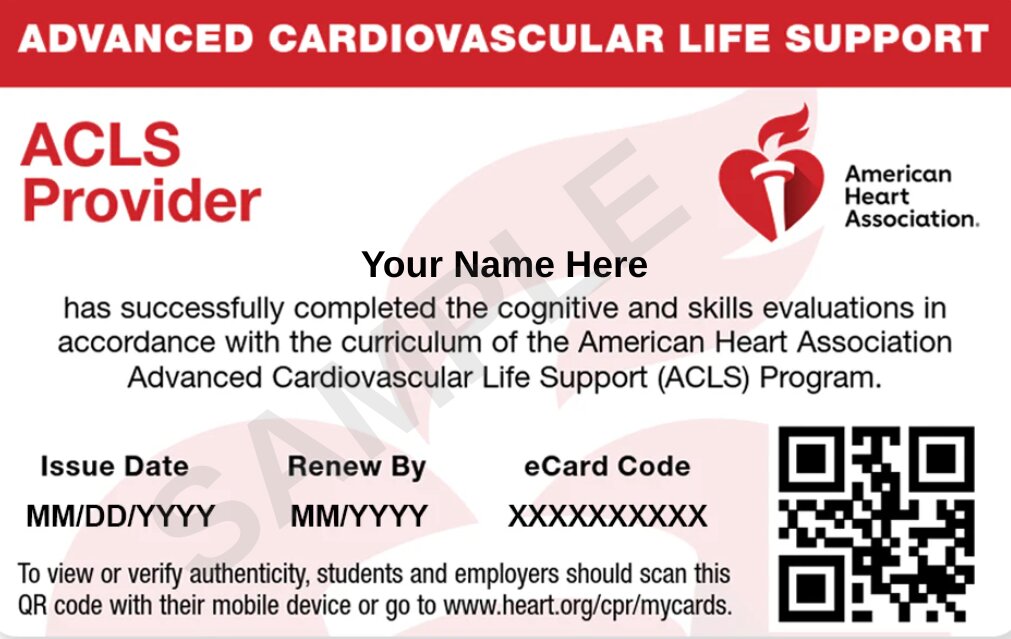
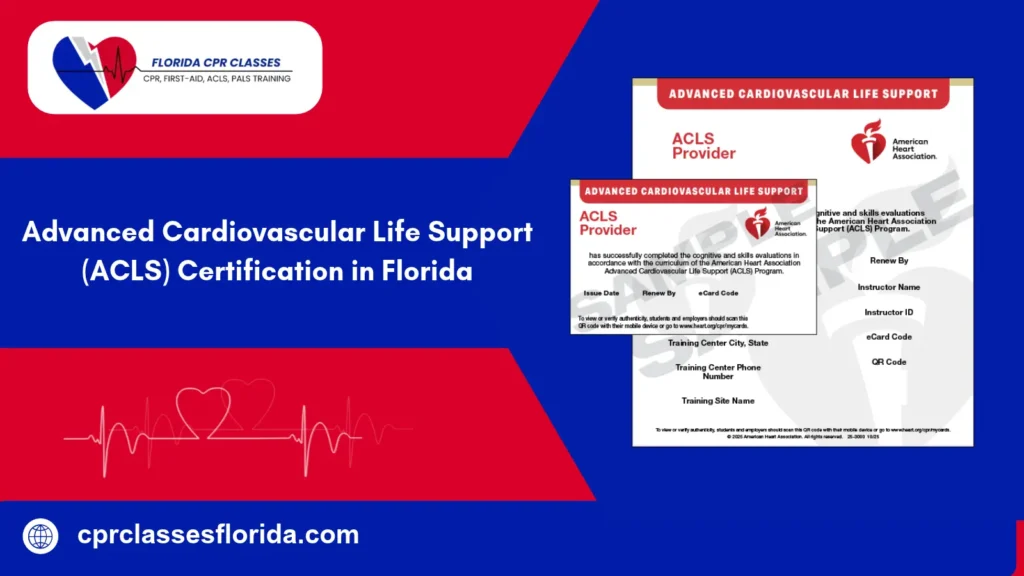
Successful completion of an ACLS course requires meeting the applicable knowledge and skills assessment requirements. Eligible participants who complete an authorized American Heart Association course receive an ACLS Provider Course Completion Card.
Who Needs ACLS Certification in Florida?
ACLS certification is particularly relevant to healthcare professionals who regularly assess, treat, or participate in the management of patients experiencing cardiac arrest and other serious cardiopulmonary emergencies.
Depending on the position and employer requirements, the following professionals may need ACLS training.
Registered Nurses
Registered nurses working in emergency departments, intensive care units, cardiac care units, and other acute care settings may need current ACLS certification to meet employment requirements.
Physicians
Physicians involved in emergency medicine, anesthesiology, cardiology, critical care, and other specialties that manage cardiovascular emergencies may benefit from ACLS training.
Paramedics and Emergency Medical Personnel
Paramedics and other eligible emergency medical professionals may require ACLS training to support their clinical responsibilities and satisfy applicable employer or professional requirements.
Respiratory Therapists
Respiratory therapists working in critical care units, emergency departments, and other acute care settings may need ACLS certification based on their job responsibilities and employer requirements.
Other Healthcare Professionals
Other clinicians who serve on resuscitation teams or manage patients with serious cardiopulmonary emergencies may also need ACLS training.
How to Get ACLS Certified in Florida
Earning ACLS certification in Florida is straightforward. Follow the steps below to complete your training and obtain your certification.
Step 1: Choose the Right ACLS Course
Choose a reputable training provider that offers a recognized ACLS certification. The American Heart Association (AHA) and American Red Cross (ARC) provide advanced life support training for healthcare professionals.
Step 2: Choose Your Training Format
Choose between in-person ACLS classes and blended learning. Select the option that fits your schedule and learning preferences.
Step 3: Prepare for Your ACLS Course
Review the course materials before attending class. Focus on basic life support (BLS), heart rhythm recognition, patient assessment, and emergency response procedures to prepare for the course assessments.
Step 4: Attend Training and Complete the Assessments
Participate in the required learning activities and complete the knowledge and practical assessments associated with your course.
Step 5: Receive Your ACLS Card
After successful completion, obtain your course completion card and check that the information is accurate. Keep a copy available for employment verification and future renewal.
What Are the Requirements for ACLS Certification?
Before enrolling in an Advanced Cardiovascular Life Support (ACLS) course, review the training prerequisites to ensure you meet the requirements.
- Current Basic Life Support (BLS) card: You must hold a valid BLS certification before starting an ACLS course.
- Basic ECG knowledge: Familiarity with common heart rhythms, such as ventricular fibrillation, ventricular tachycardia, and bradycardia, helps participants prepare for rhythm recognition.
- Basic pharmacology knowledge: Understanding the role of emergency medications helps participants follow resuscitation protocols.
- Airway management basics: Knowledge of airway assessment, oxygenation, and ventilation provides a foundation for advanced resuscitation.
- Healthcare professional eligibility: ACLS training is intended primarily for healthcare professionals involved in managing cardiopulmonary emergencies. Employer requirements may vary.
- Precourse preparation: Participants may need to complete assigned learning materials or an online self-assessment before attending class.
ACLS Training Formats Available in Florida
Healthcare professionals in Florida can choose between traditional ACLS training and blended learning. Both formats cover advanced resuscitation skills, but they differ in how participants complete the coursework and practical training.
Traditional ACLS Training
Traditional ACLS training takes place in a classroom under the guidance of an experienced instructor. Participants follow demonstrations, practice the required skills, and receive feedback during hands-on sessions to improve their performance. This format requires participants to attend scheduled classroom sessions, which can take more time than blended learning. It is recommended for healthcare professionals who prefer face-to-face instruction and direct interaction with an instructor.
Blended ACLS Learning
Blended ACLS learning combines online coursework with an in-person, hands-on skills session. Participants complete the online portion at their own pace before attending practical training. During the skills session, they use a self-guided training station equipped with voice-assisted manikins that guide them through ACLS procedures, provide real-time feedback, and assess their competency. This format offers flexibility, letting healthcare professionals study at their own pace and fit training around their work schedules.
Both traditional and blended ACLS training lead to the same certification when you complete the required course and assessments. Choose the format that best fits your schedule, learning preferences, and professional needs.
How Much Does ACLS Certification Cost in Florida?
ACLS certification prices in Florida vary by training provider and course format.
At Florida CPR Classes, the following ACLS training options are available:
- ACLS Certification Course (Online + Skills): $295
- Skills Session Only: $150
How Long Does ACLS Certification Take?
The time required to complete ACLS certification in Florida depends on the training format and whether you are taking an initial or renewal course. An initial classroom ACLS course typically takes 13 to 16.5 hours, often spread over one or two days. Renewal courses generally take around 4 to 6 hours.
For blended ACLS training, the American Heart Association’s HeartCode ACLS format includes approximately 3 to 6 hours of self-paced online learning, followed by an in-person skills session that may take 30 minutes to 6 hours, depending on the course requirements.
These timeframes are estimates, so check with your training provider for the exact schedule before enrolling.
How Long Is ACLS Certification Valid in Florida?
An American Heart Association ACLS Provider Course Completion Card is valid for two years.
Healthcare professionals should check the expiration date printed on their card and plan their next course before it expires.
If you are changing employers, confirm that your new workplace accepts your existing credential and that the card remains valid for the required period.
How to Renew ACLS Certification in Florida
Renewing ACLS certification helps healthcare professionals maintain current resuscitation knowledge and meet workplace credentialing requirements.
Follow these steps when preparing for renewal.
1. Check Your Current Card
Review the expiration date and determine which course your employer requires.
2. Confirm Your Eligibility for a Renewal Course
Ask an authorized training provider whether you qualify for an ACLS renewal course or need to complete the initial provider course.
3. Review Current Resuscitation Guidance
Refresh your understanding of cardiac rhythms, resuscitation algorithms, airway management, emergency medications, and team communication.
4. Complete the Required Training
Attend the selected course and successfully complete its required assessments.
5. Verify Your Updated Credential
Check your new completion card and submit it to your employer according to workplace policy.
ACLS vs. BLS Certification: What Is the Difference?
BLS and ACLS certification prepare healthcare professionals to respond to medical emergencies at different levels. BLS establishes the essential skills needed to recognize cardiac arrest and provide immediate resuscitation, while ACLS focuses on clinical decision-making and advanced interventions during life-threatening cardiovascular emergencies.
| Feature | BLS Certification | ACLS Certification |
| Full Name | Basic Life Support | Advanced Cardiovascular Life Support |
| Training Focus | Early recognition of cardiac arrest and immediate resuscitation | Assessment and treatment of complex cardiovascular emergencies |
| Patient Population | Adults, children, and infants | Primarily adults |
| Clinical Skills | CPR, AED use, rescue breathing, and bag-mask ventilation | Cardiac rhythm interpretation, advanced airway management, vascular access, and electrical therapies |
| Medication Knowledge | Basic emergency response; advanced resuscitation medications are not a central focus | Use of emergency medications, including epinephrine and amiodarone, during resuscitation |
| Team Responsibilities | Performing resuscitation tasks and communicating with other responders | Coordinating advanced resuscitation, assigning team roles, and making treatment decisions |
| Prerequisites | No | Current BLS certification is commonly required |
| Needed By | Nurses, physicians, EMTs, paramedics, dental professionals, and other healthcare workers | Physicians, nurses, paramedics, and other healthcare professionals involved in advanced cardiovascular care |
How to Choose the Right ACLS Training Provider in Florida
Before enrolling in an ACLS certification course in Florida, consider these factors to ensure the training meets your clinical needs and workplace requirements.
- Accreditation: Choose an American Heart Association (AHA) ACLS course if your employer requires AHA certification.
- Course Format: Compare classroom training with blended learning options that combine online coursework and in-person skills practice.
- Hands-On Training: Confirm that the course includes practical skills practice and an assessment of your ability to apply ACLS protocols.
- Prerequisites: Check whether you need a current BLS certification and any required knowledge of ECG interpretation, pharmacology, and basic resuscitation.
- Training Equipment: Ask whether the skills session includes voice-assisted manikins or other equipment to help you practice resuscitation procedures and receive feedback.
- Schedule and Location: Review available class dates, session times, and training locations before registering.
- Total Cost: Confirm whether the fee covers online learning, the in-person skills session, and the certification card.
- Certification Requirements: Verify that the course meets your employer’s or professional licensing organization’s requirements before enrolling.
Enroll in an ACLS Certification Course in Florida
ACLS certification helps healthcare professionals develop the advanced skills needed to manage cardiac arrest and other serious cardiovascular emergencies. Whether you need ACLS for your current clinical role or are renewing your certification, choose a course that meets your employer’s requirements and includes the necessary training and skills assessment.
Florida CPR Classes offers American Heart Association (AHA) ACLS certification through blended learning, combining self-paced online coursework with an in-person skills session. Practice essential ACLS procedures using voice-assisted manikins that provide real-time feedback and assess your competency. After completing the required coursework and skills assessment, you can receive your ACLS Provider eCard upon successful completion.
Frequently Asked Questions About ACLS Certification in Florida
Is ACLS the same as BLS?
No. BLS focuses on foundational life support skills, while ACLS covers advanced assessment and management of adult cardiopulmonary emergencies. Some healthcare positions require both.
Does Florida require all healthcare workers to have ACLS certification?
No universal ACLS requirement applies to every healthcare worker. Requirements depend on the position, employer, and applicable professional rules.
How can I verify that an ACLS course meets my employer’s requirements?
Ask your employer which issuing organization and course completion card it accepts. Confirm those details with the training provider before enrolling.
Is ACLS Certification Recognized Outside Florida?
Yes. American Heart Association (AHA) ACLS certification is widely accepted by healthcare employers across the United States.