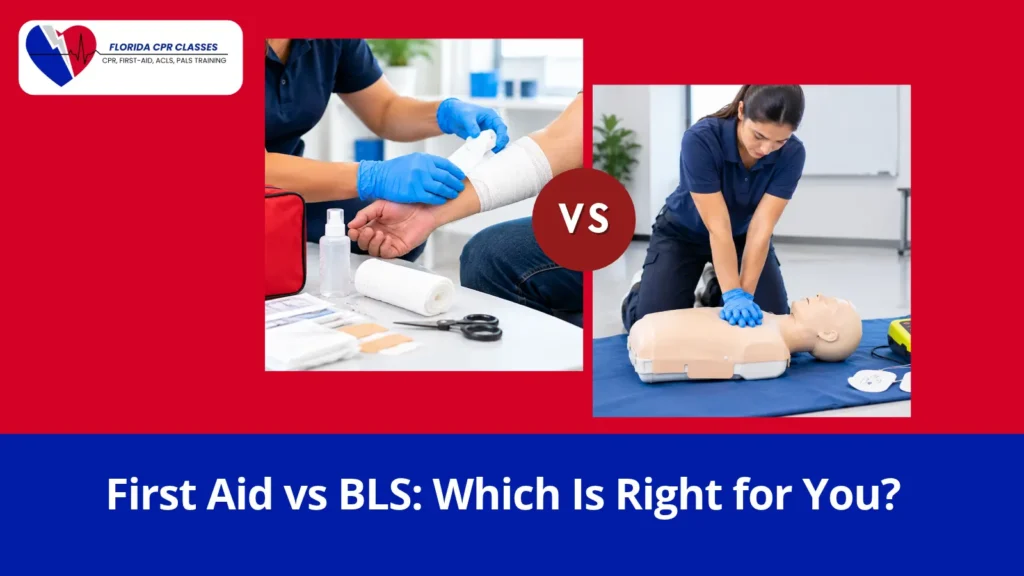
First aid and Basic Life Support (BLS) both teach emergency response skills, but each covers different situations and procedures. First aid teaches how to provide initial care for injuries and sudden illnesses. BLS covers CPR, rescue breathing, and AED use during life-threatening situations.
Choosing between first aid and BLS depends on your responsibilities, the type of emergencies you may encounter, and your employer’s certification requirements. This guide explains the key differences between first aid and BLS, what each course covers, who needs each certification, and how to choose the right training for your needs.
What Is First Aid?
First aid is immediate care given to someone who is injured or becomes ill, such as treating a cut, burn, or sudden medical problem. It involves assessing the person’s condition, providing appropriate care, and seeking further medical help when necessary.
First aid training commonly covers:
- Bleeding control: Applying pressure to a wound to slow or stop the bleeding.
- Burns and injuries: Providing initial care for burns, cuts, sprains, and other common injuries.
- Medical emergencies: Recognizing warning signs of a stroke, heart attack, seizure, or diabetic emergency.
- Allergic reactions: Recognizing severe allergic reactions and responding appropriately.
- Choking: Identifying airway obstructions and providing appropriate choking assistance.
- Environmental emergencies: Providing first aid for heat exhaustion, heatstroke, and hypothermia.
The exact skills depend on the course. Some first aid programs cover only injury and illness management, while others combine first aid with CPR and AED training.
What Is BLS?
Basic Life Support (BLS) is emergency response training that focuses on recognizing life-threatening conditions and providing immediate resuscitation. It is particularly relevant to healthcare professionals and other personnel who need CPR and basic cardiovascular life support skills.
BLS certification commonly covers:
- High-quality CPR: Performing chest compressions for adults, children, and infants.
- Rescue breathing and ventilation: Providing appropriate breaths and ventilation during resuscitation.
- AED use: Operating an automated external defibrillator to help treat sudden cardiac arrest.
- Choking relief: Responding to foreign body airway obstructions.
- Team-based resuscitation: Developing effective team dynamics by assigning roles, communicating clearly, and working together during CPR.
- Emergency recognition: Recognizing when someone is in cardiac arrest and starting CPR and other life support measures.
BLS courses generally include hands-on skills practice and assessment. The specific requirements depend on the training provider and course format.
What Are the Key Differences Between First Aid and BLS?
The main difference between first aid and BLS is the scope of training. First aid covers a broad range of injuries and illnesses, whereas BLS concentrates on CPR, ventilation, AED use, and resuscitation teamwork.
| Feature | First Aid | BLS |
| Main purpose | Provide initial care for injuries and illnesses | Support breathing and circulation during life-threatening conditions |
| Primary focus | Injury management and medical emergencies | CPR and basic life support |
| CPR training | Included in some courses | Core component |
| AED training | Included in some courses | Core component |
| Injury management | Covers burns, bleeding, sprains, and other injuries | Not the primary focus |
| Ventilation | Depends on the course | Included in standard BLS training |
| Team-based resuscitation | Depends on the course | Important part of BLS training |
| Typical audience | General public, employees, teachers, and caregivers | Healthcare professionals and other personnel who require BLS |
| Certification requirements | Depend on the course and provider | Depend on the course and provider |
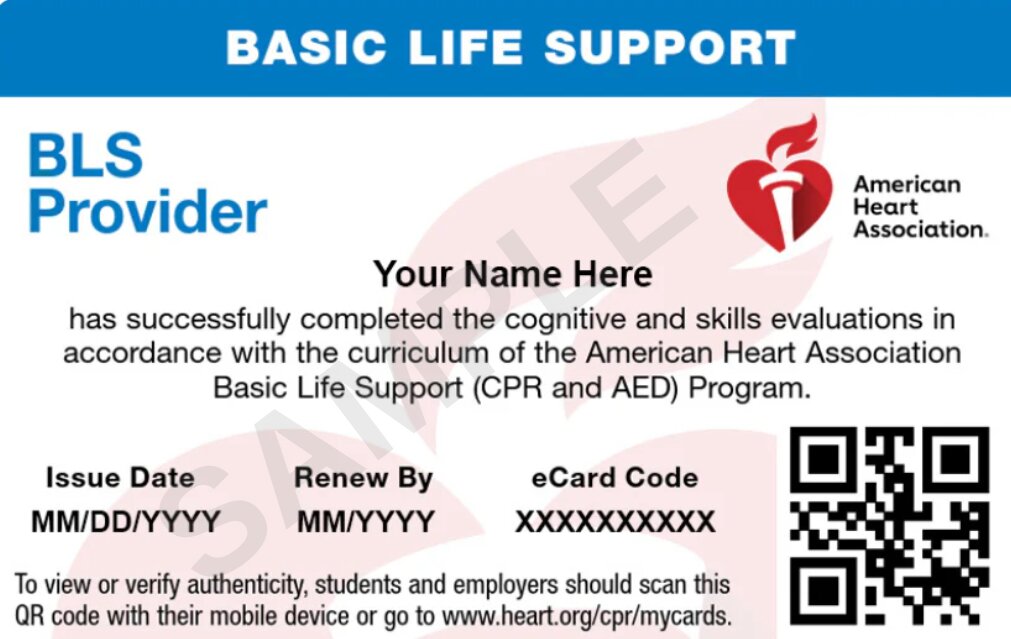
| Certification validity | Varies by provider | AHA BLS Provider cards are generally valid for two years |
| Team roles | Does not typically assign specific resuscitation roles | Includes 3 critical BLS roles: compressor, airway provider, and monitor/defibrillator/CPR coach. |
| Who should take it? | Teachers, caregivers, workplace employees, and the general public. | Healthcare professionals, EMTs, nurses, and other personnel required to perform BLS. |
Is BLS the Same as First Aid?
No. BLS and first aid are separate emergency response courses that cover different skills and situations. First aid focuses on initial care for injuries and illnesses, while BLS emphasizes CPR, ventilation, AED use, and resuscitation.
Completing one course does not automatically mean you have completed the other. If your job requires both certifications, you must complete each course separately.
Does BLS Include First Aid?
No. BLS training focuses on CPR, rescue breathing, AED use, and resuscitation, rather than the broader range of injuries and illnesses covered in first aid training.
If your job requires you to provide first aid for injuries such as burns, cuts, or sprains, check whether you also need a separate first aid certification.
Which Certification Should You Choose?
Check your job requirements to determine whether you need First Aid training, BLS training, or both.
Choose First Aid if:
- You need to learn how to manage cuts, burns, and other common injuries.
- You want to learn how to control bleeding and respond to sudden illnesses.
- Your workplace requires first aid training.
Choose the BLS course if:
- You work in healthcare or need a BLS certification for your job.
- You need to learn resuscitation skills for adults, children, and infants.
- You need to learn effective team dynamics and critical roles during resuscitation.
Can You Take First Aid and BLS Together?
Yes. You can complete both courses if your job or personal goals require both first aid and life support skills. However, they may be offered as separate courses rather than one combined certification.
Taking both provides broader emergency response preparation. First aid training helps you respond to injuries and sudden illnesses, while BLS training builds practical skills for cardiac arrest, respiratory emergencies, and team-based resuscitation.
How Long Do First Aid and BLS Certifications Last?
Certification validity depends on the training organization and the specific course.
American Heart Association (AHA) BLS and First Aid certifications are valid for two years.
Check the expiration date on your completion card and renew your certification as required by your employer and training provider.
Get Certified with Florida CPR Classes
First aid and BLS certifications serve different purposes, from managing common injuries to providing life support during cardiac emergencies. Choose a course based on whether your job requires First Aid certification, BLS certification, or both.
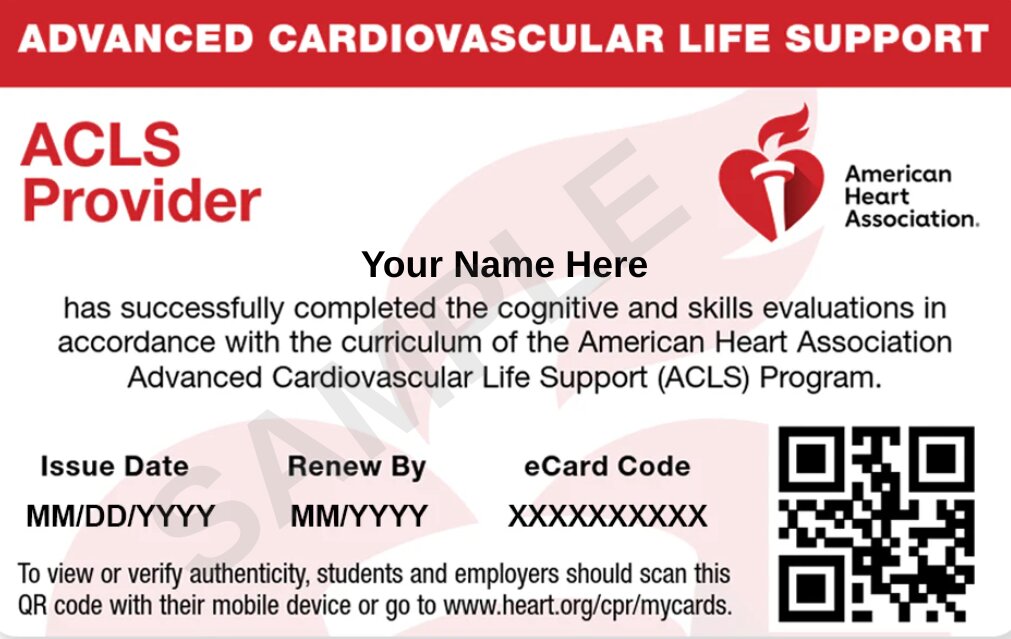
Florida CPR Classes offers AHA BLS, ACLS, and PALS courses for healthcare professionals. Our training helps you develop essential life support skills and earn nationally recognized certification.
We have multiple training locations across Florida, making it easier to find a convenient class near you. Explore our available courses to choose the certification that meets your professional requirements.
Frequently Asked Questions
Is first aid better than BLS?
Neither is better in every situation. First aid teaches you how to respond to injuries and sudden illnesses, while BLS focuses on CPR, rescue breathing, and other life support skills. The right course depends on your job duties and your employer’s certification requirements.
Can I get a BLS certification without taking first aid?
Yes. You can take a standalone BLS course without completing a first aid course, as long as you meet the training provider’s requirements.
Does first aid certification qualify me to perform CPR?
Only if the course includes CPR training. A standard first aid course may not include CPR or AED training. Check the course content or choose a combined First Aid CPR AED course if you need to learn all three skills.
Is BLS only for healthcare professionals?
No. Although BLS is primarily aimed at healthcare professionals, other personnel may take it when their employer or responsibilities require basic life support skills. Check the intended audience and acceptance requirements of the specific course.
Do first aid and BLS certifications have the same requirements?
No. Course content, practical assessments, eligibility criteria, and renewal periods can differ. Confirm the requirements for each credential with the training provider and your employer.
Can a First Aid CPR AED course replace BLS certification?
Not necessarily. A combined First Aid CPR AED course may cover CPR and AED use, but it may not meet the specific requirements of a BLS Provider credential. If your employer requires BLS, choose a course that explicitly meets that requirement.