During a cardiac arrest, healthcare professionals must act quickly while coordinating chest compressions, ventilation, and AED use. Even when each rescuer knows how to perform these tasks, poor communication or unclear responsibilities can disrupt the resuscitation effort.
Effective team dynamics in BLS help rescuers coordinate chest compressions, ventilation, and AED use by communicating clearly and ensuring each team member understands their responsibilities. This guide covers 10 examples of effective team dynamics in BLS, essential team roles, communication skills, common teamwork challenges, and strategies to improve coordination during resuscitation.
What Are Effective Team Dynamics in BLS?
Effective team dynamics in BLS refer to how rescuers communicate, coordinate responsibilities, make decisions, and support one another while providing basic life support. These behaviors help healthcare professionals coordinate their efforts, maintain high-quality CPR, and deliver effective resuscitation.
Effective BLS team dynamics involve several core competencies:
- Leadership: Coordinating the response and assigning responsibilities.
- Communication: Clearly sharing instructions, observations, and important updates with the team.
- Role clarity: Ensuring each team member understands their assigned tasks.
- Mutual support: Helping colleagues and addressing problems when they arise.
- Situational awareness: Monitoring the patient, the team, and changes in the emergency.
- Constructive intervention: Speaking up when an error or potential safety concern is identified.
- Workload management: Distributing responsibilities to prevent confusion and unnecessary delays.
The American Heart Association (AHA) recognizes teamwork competencies, including leadership, communication, and workload management, as important elements of resuscitation training. These skills complement technical CPR abilities and support coordinated emergency care.
10 Practical Examples of Effective Team Dynamics in BLS
The following examples demonstrate how healthcare professionals can apply teamwork principles during BLS emergencies.
1. Assigning Clear Roles Before Starting Resuscitation
When multiple rescuers respond to a cardiac arrest, each person needs to understand their responsibilities. Without clear assignments, two people might perform the same task while another essential intervention is delayed.
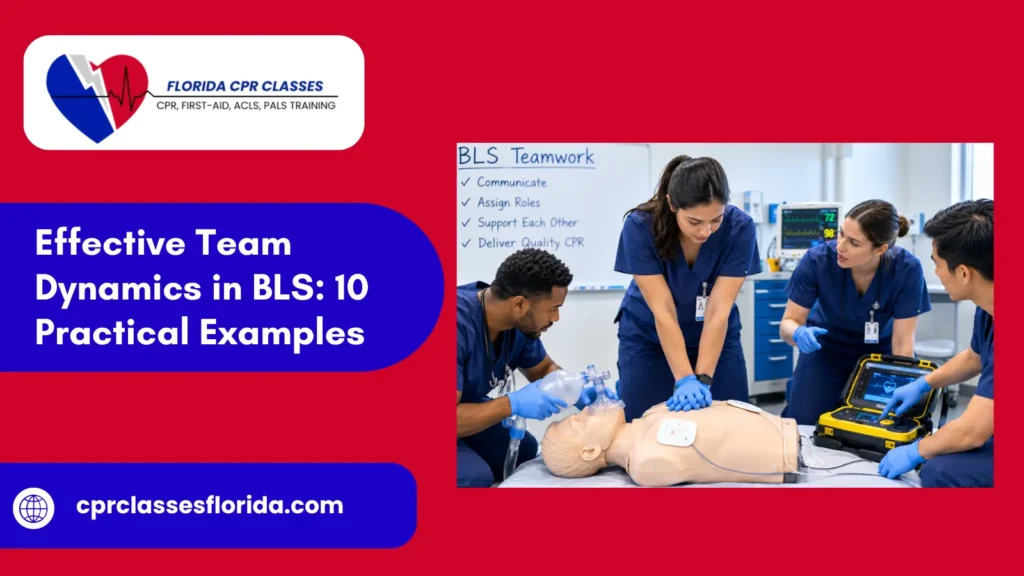
For example, a team leader can assign one rescuer to perform chest compressions, another to manage the airway and provide ventilation, and a third to retrieve and operate the AED. In a larger team, another member may document events and monitor intervention times.
Why it matters: Clear role allocation reduces duplicated effort, prevents missed tasks, and helps team members coordinate their actions. Team responsibilities should reflect the number of available rescuers, their training, and the equipment on hand.
2. Using Closed-Loop Communication
Closed-loop communication ensures that instructions are heard, understood, and completed correctly. Rather than assuming a team member understood an instruction, the person giving it receives verbal confirmation.
For example, the team leader says, “Alex, attach the AED pads.” Alex responds, “Attaching the AED pads now.” Once the pads are attached, Alex reports, “AED pads are attached.”
The team leader can then confirm the task and communicate the next instruction.
Why it matters: Closed-loop communication reduces ambiguity and helps prevent important tasks from being overlooked during a stressful resuscitation. The AHA’s TeamSTEPPS resources describe this communication method as a way to reduce communication errors in healthcare.
3. Maintaining Clear Leadership During Cardiac Arrest
A designated team leader coordinates the resuscitation effort, communicates priorities, and monitors the team’s overall performance. Leadership does not mean performing every task personally. Instead, the leader ensures that each task is assigned to a team member with the appropriate skills and training.
For example, when a patient experiences cardiac arrest, the team leader confirms that CPR is underway, assigns the AED role, coordinates airway management, and monitors the response to interventions.
The leader also requests updates and addresses problems when the patient’s condition or the team’s needs change.
Why it matters: Effective leadership provides direction and helps prevent confusion when several interventions must occur together. A calm, organized leader also encourages team members to communicate concerns promptly.
4. Coordinating Chest Compressions and Ventilation
High-quality CPR requires coordination between chest compressions and ventilation. Team members responsible for compressions and airway management must communicate so that ventilation is delivered appropriately and interruptions remain as short as possible.
For example, the compressor continues chest compressions while the airway rescuer prepares to provide the required breaths. The team coordinates any necessary pause and resumes compressions promptly.
For adult CPR without an advanced airway, trained healthcare providers generally use a ratio of 30 compressions to 2 breaths. When an advanced airway is in place, the CPR team follows the applicable resuscitation protocol.
Why it matters: Poor coordination can lead to unnecessary interruptions or delays in ventilation. Communication between the compressor and airway rescuer helps maintain effective CPR.
5. Rotating the Compressor Before Excessive Fatigue
Chest compressions require physical effort, and fatigue can reduce compression quality. Team members should monitor the compressor and coordinate a timely change when another trained rescuer is available.
For example, the team leader or CPR coach announces that the compressor rotation is approaching. The incoming rescuer prepares to take over, and the team changes compressors at an appropriate point, such as during the AED rhythm analysis when feasible.
For adult CPR, rescuers generally switch compressors about every two minutes, or sooner if the current compressor becomes fatigued. The leader assigns each task to a team member with the necessary training and skills.
Why it matters: Planned rotations help maintain compression quality and prevent avoidable delays while changing rescuers.
6. Coordinating AED Use With Ongoing CPR
An automated external defibrillator analyzes the heart rhythm and advises whether a shock is indicated. The team must coordinate AED placement, pad attachment, rhythm analysis, and shock delivery while following the device’s prompts.
For example, one rescuer continues CPR while another prepares the AED. When the AED analyzes the heart rhythm, team members must ensure that no one touches the patient. If a shock is advised, the team follows the AED’s safety instructions and resumes CPR promptly when directed.
Why it matters: Defined responsibilities help the team prepare the AED efficiently, maintain safety, and minimize unnecessary interruptions in chest compressions.
7. Sharing Patient Updates and Clinical Observations
Team members should report changes in the patient’s condition, updates on ongoing interventions, and any concerns that could affect resuscitation.
For example, a team member reports a change in the patient’s heart rhythm on the monitor, while the airway rescuer reports difficulty providing effective ventilation. The team leader uses this information to coordinate reassessment and appropriate next steps.
Team members should confirm when they complete a task and report any problems that prevent them from performing an intervention correctly.
Why it matters: Sharing observations helps the team maintain a common understanding of the situation. It also helps the team leader identify problems and take appropriate action.
8. Speaking Up to Correct Errors or Safety Concerns
Effective teamwork requires team members to identify potential errors and raise concerns respectfully, regardless of their position within the team.
For example, if a rescuer notices that chest compressions are too shallow, they should inform the team and suggest correcting the compression depth.
Similarly, a team member who identifies an unsafe action during AED use should alert the team immediately.
The team leader should encourage questions, acknowledge useful feedback, and correct problems without discouraging further communication.
Why it matters: Constructive intervention helps prevent errors from continuing and supports a culture in which patient safety takes priority over hierarchy.
9. Recognizing Limitations and Requesting Assistance
Every rescuer has limits in their training, experience, and physical ability. Effective team dynamics include recognizing those limitations and asking for help before they interfere with patient care.
For example, if a team member is unfamiliar with a particular piece of equipment, they should communicate this limitation and request assistance from a qualified colleague. If a task exceeds their scope of practice, the team leader should assign it to an appropriately trained professional.
Team members should also communicate when they are becoming fatigued or unable to complete an assigned task safely.
Why it matters: Recognizing limitations allows the team to distribute responsibilities appropriately and reduces the risk of preventable errors.
10. Conducting a Team Debrief After Resuscitation
A team debrief provides an opportunity to review the resuscitation effort, identify successful practices, and discuss areas for improvement. It may take place immediately after the event or later, depending on the circumstances.
For example, the team may discuss whether role assignments were clear, whether instructions were acknowledged, whether interruptions in CPR could have been reduced, and whether equipment or communication problems affected performance.
The discussion should focus on specific observations and practical improvements rather than assigning blame.
Why it matters: Debriefing helps teams identify opportunities to improve communication, coordination, and performance during future emergencies. The AHA includes debriefing among its resuscitation education and quality improvement resources.
Key BLS Team Roles During an Emergency
Effective BLS teamwork requires clear responsibilities and coordination during resuscitation. The three primary BLS roles are the compressor, airway provider, and monitor/defibrillator/CPR coach. The team can assign extra roles based on how many rescuers are available and what resources they have.
| Team role | Main responsibility |
| Compressor | Performs chest compressions and maintains CPR quality. |
| Airway provider | Opens the airway and provides appropriate ventilation. |
| Monitor/defibrillator/CPR coach | Operates the AED or defibrillator, follows its prompts, monitors CPR quality, and provides feedback. |
| Team leader | Coordinates the response, assigns tasks, and monitors overall team performance. |
| Recorder or timer | Tracks intervention times and documents key events when staffing permits. |
| Additional rescuer | Assists with equipment, supports role transitions, or performs other necessary tasks as directed. |
Although the first three are the primary BLS team roles, the other responsibilities help coordinate care when additional rescuers are available. In smaller teams, one person may perform multiple tasks according to their training and the immediate needs of the resuscitation.
What Are the Main Communication Skills Used in BLS Team Dynamics?
Effective communication in BLS means giving clear instructions, confirming that team members understand them, and sharing important updates about the patient’s condition. Team members should acknowledge instructions, share observations, give constructive feedback, and stay aware of changing priorities.
Important communication techniques include:
- Closed-loop communication: The receiver repeats the instruction to confirm understanding, and the sender verifies that the message is correct.
- Clear, concise messages: Instructions identify the task and, when appropriate, the person responsible.
- Callouts: Team members announce important observations, such as a change in patient status or an AED prompt.
- Knowledge sharing: Rescuers communicate relevant findings and concerns that may affect patient care.
- Constructive feedback: Team members respectfully address errors or opportunities to improve performance.
- Regular updates: The team leader summarizes progress and confirms that essential responsibilities are being completed.
These techniques support a shared understanding of the emergency and help prevent communication failures during resuscitation.
What Happens When BLS Team Dynamics Are Poor?
Poor team dynamics can interfere with coordinated emergency care. Even skilled rescuers may struggle to perform CPR effectively when responsibilities are unclear, and communication is poor.
Common examples of poor BLS teamwork include:
- Two rescuers performing the same task while another task remains incomplete.
- Team members assuming instructions have been understood without confirmation.
- Delayed compressor rotations that allow fatigue to affect compression quality.
- Unnecessary interruptions during chest compressions.
- Failure to communicate changes in the patient’s condition.
- Team members remaining silent when they notice a potential error.
- A team leader failing to coordinate tasks or monitor overall progress.
These problems can often be addressed through clear role assignments, structured communication, skills practice, and team debriefing. Teamwork training complements technical BLS training by helping healthcare professionals apply their skills in coordinated emergency situations.
How Can Healthcare Professionals Improve Team Dynamics in BLS?
Healthcare professionals can strengthen their teamwork skills through regular practice, feedback, and review of emergency scenarios.
- Practice realistic scenarios: Participate in simulated cardiac arrest situations that require multiple rescuers to coordinate CPR, ventilation, and AED use.
- Rehearse closed-loop communication: Practice giving clear instructions, repeating assignments, and confirming task completion.
- Clarify responsibilities early: Assign available team members to essential tasks before confusion develops.
- Monitor CPR performance: Use feedback and coaching when available to identify problems with compression quality or interruptions.
- Encourage respectful communication: Create an environment in which team members can ask questions and raise safety concerns.
- Review performance after practice: Discuss what went well, identify specific gaps, and repeat scenarios to improve coordination.
AHA BLS certification provides an opportunity to practice CPR and AED skills. Healthcare professionals can improve teamwork by practicing BLS scenarios together, reviewing their performance, and learning from feedback.
Strengthen Your Teamwork Through BLS Training
Effective team dynamics in BLS help healthcare professionals coordinate chest compressions, ventilation, and AED use during cardiac arrest. Clear communication, defined roles, effective leadership, and mutual support help rescuers work together and deliver high-quality CPR with minimal interruptions.
Florida CPR Classes offers American Heart Association (AHA) BLS, ACLS, and PALS training for healthcare professionals seeking to develop their resuscitation skills. With flexible course options and multiple locations across Florida, students can complete online coursework before attending an in-person skills session and receive their AHA provider card on the same day after successfully completing the required course components.
Frequently Asked Questions About Effective Team Dynamics in BLS
Which team role provides feedback on compressions and breaths?
The CPR coach monitors CPR quality and provides feedback to help rescuers maintain effective chest compressions and ventilation.
What Is the Difference Between BLS Team Dynamics and CPR Skills?
CPR skills are the technical actions used to provide resuscitation, including chest compressions, ventilation, and AED use. BLS team dynamics involve the communication, leadership, coordination, and mutual support that help rescuers perform these actions effectively as a team.
How Often Should Rescuers Switch During Adult CPR?
When multiple trained rescuers are available, they generally switch the person performing chest compressions about every two minutes, or sooner if fatigue develops. The team should plan the transition to minimize interruptions in chest compressions.
Does BLS Training Include Teamwork and Communication?
BLS training can include teamwork and communication practice, especially in multiple-rescuer scenarios. Course content varies by provider and course format, so learners should check the requirements of their specific BLS course.
What Are the Five Dynamics of an Effective BLS Team?
The five key dynamics of an effective BLS team are clear communication, clear roles and responsibilities, effective leadership, mutual support, and situational awareness. These principles help rescuers coordinate chest compressions, ventilation, and AED use during resuscitation.